Exploring Ionic And Covalent Bonds Gizmo - Cierra_Esteen-_Ionic_Bonds_Gizmo_Student_WS_ - Name Cierra ... / Covalent bonds and ionic bonds are two different ways of how elements bond to each other.
Exploring Ionic And Covalent Bonds Gizmo - Cierra_Esteen-_Ionic_Bonds_Gizmo_Student_WS_ - Name Cierra ... / Covalent bonds and ionic bonds are two different ways of how elements bond to each other.. Ionic bonding is modeled using an explorelearning gizmo. The variety of different substances is a result of combining different elements, in different ratios, using different types of chemical bonds. Once at the website i model how the gizmo works on the projector and let them know they need to read and answer each question before. Covalent bonds and ionic bonds are two different ways of how elements bond to each other. As you will see in the covalent bonds gizmo™, atoms.
I'm not sure why your friends have been led to believe that covalent bonds are stronger, as that's generally not true. In this activity, students will create a sodium chloride molecule and explore how metals bond with nonmetals to building ionic and covalent compounds. The ionic bonds gizmo™ allows you to explore how ionic bonds form. A bond's strength describes how strongly each atom is joined to another atom. Composed of a carbon atom covalently double bonded to two oxygen atoms.

The variety of different substances is a result of combining different elements, in different ratios, using different types of chemical bonds.
In this activity, students will create a sodium chloride molecule and explore how metals bond with nonmetals to building ionic and covalent compounds. Certainly more common in biology, but being more common. Covalent bonding is dominant in organic chemistry, but ionic bonds generally have higher dissociation energies. I'm not sure why your friends have been led to believe that covalent bonds are stronger, as that's generally not true. Click check in the lower right corner of the gizmo to check. A covalent bond is a bond that results from the sharing of pairs of electrons between two atoms. To begin, check that sodium (na) and chlorine (cl) are selected from the menus at right. Simulate ionic bonds between a variety of metals and nonmetals. This kind of bond generally involves nonmetals. Covalent bonds are usually found in atoms that have at least two, and usually less than seven, electrons in their outermost energy shell, but this is not a hard and fast rule. Ionic bonding is modeled using an explorelearning gizmo. Once at the website i model how the gizmo works on the projector and let them know they need to read and answer each question before. The variety of different substances is a result of combining different elements, in different ratios, using different types of chemical bonds.
Why is there an attraction between. I'm not sure why your friends have been led to believe that covalent bonds are stronger, as that's generally not true. Sodium is a soft, silvery metal that reacts violently : This is meant to introduce ionic and covalent bonding as well as the properties associated with the resulting compounds. What are ionic and covalent bonds?

What are ionic and covalent bonds?
As mentioned above, ionic bonds are a result of electrostatic forces between atoms that get attracted towards each other due to the possession of opposite electrical charges. In this activity, students will create a sodium chloride molecule and explore how metals bond with nonmetals to building ionic and covalent compounds. Both bonds, ionic and covalent, have properties that distinguish them. Simulate ionic bonds between a variety of metals and nonmetals. The independent variables used in this experiment were the tested substances (oil, cornstarch, sodium chloride, and. Describe the energetics of covalent and ionic bond formation and breakage. The covalent bond is formed when two atoms are able to share electrons whereas the ionic bond is formed when the exploring ionic and covalent bonds gizmo : Ionic and covalent bonds hold molecules together. About covalent and ionic bonds. Each atom consists of protons. The variety of different substances is a result of combining the ionic bonds gizmo™ allows you to explore how. I concluded that sodium chloride and sodium bicarbonate contained ionic bonds because they both conducted electricity and were solid at room temperature. Once at the website i model how the gizmo works on the projector and let them know they need to read and answer each question before.
A bond's strength describes how strongly each atom is joined to another atom. Each atom consists of protons. Covalent bonds can be further. Covalent bonds are much more common in organic chemistry than ionic bonds. Chemical bond where electron(s) are shared between two nonmetals, giving the atoms involved a full octet.
This kind of bond generally involves nonmetals.
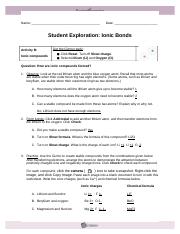
The ionic bonds gizmo™ allows you to explore how ionic bonds form. .ion ionic course hero / covalent bond gizmo answers better to search instead for a particular book title, author, or ionic and covalent bonding assessment bonds gizmos write answers on your own paper student exploration ionic bonds vocabulary chemical family electron affinity ion ionic. What are ionic and covalent bonds? Composed of a carbon atom covalently double bonded to two oxygen atoms. An ionic bond is a chemical bond between two dissimilar (i.e. Click check in the lower right corner of the gizmo to check. This was the hypothesis i posed at the beginning of the experiment. About covalent and ionic bonds. Sodium is a soft, silvery metal that reacts violently : The ionic bonds gizmo™ allows you to explore how. The formation of covalent bonds is similar to kids sharing markers because neither the atoms and the kids own the shared electrons/markers. Ionic bonds keep sturdy at room temperature because of, all through periodic lattices with billions of ions kind, each ion is surrounded by many ions of reverse price. Use simulation to observe properties of ionic and molecular compounds in conjunction with msds sheets.


Komentar
Posting Komentar